My Experience With the Bridges Program
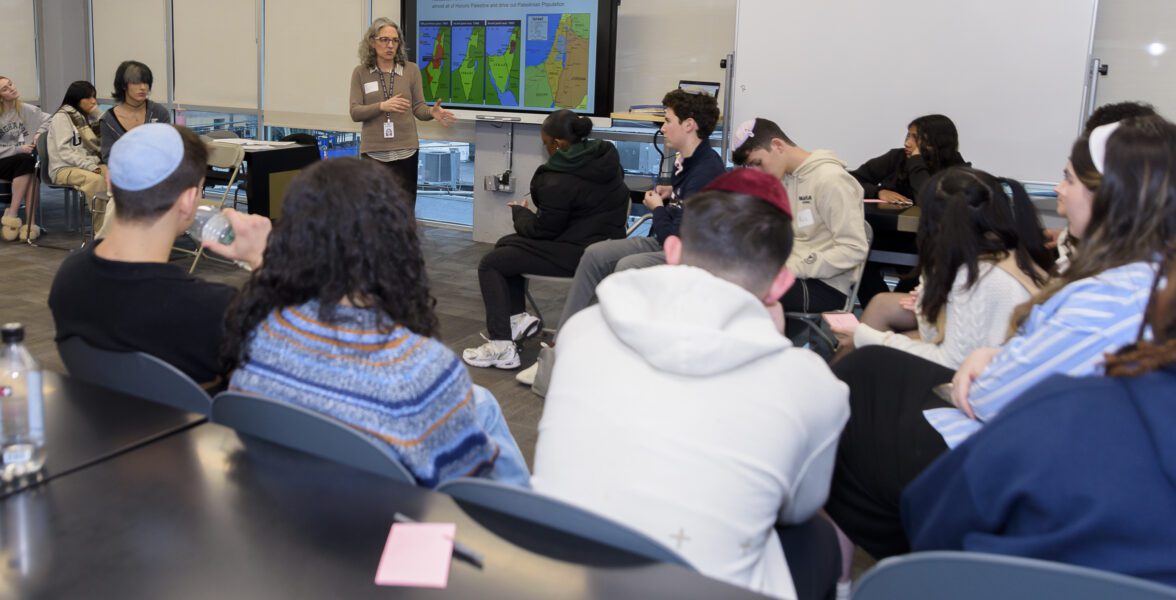
When I applied to the Bridges program, I was excited by the idea of befriending people with different backgrounds from me and learning about other cultures. I was also curious to see how I, and other SAR students, would form connections despite our differences. The monthly program, led by Dr. Caryn Keller and Ms. Adina Shoulson from SAR’s history department, brings together SAR students and students from Comp Sci High, a charter school in the Bronx that “empowers students with the academic and tech skills they need to access college, jobs, and social empowerment.” Before the first event, although I was eager to begin, I had many fears. I was tasked with a big responsibility: to represent the Jewish people to those who know very little about us. I was nervous that I might say the wrong thing, damaging their view of the Jewish community.
Before the first meeting, Ms. Shoulson prepped us with strategies for civil discourse in case arguments arose, including the “Ouch, oops” method: if someone offended us or said something hurtful, we would respond gently, indicating how that hurt and why, the “ouch.” In the opposite circumstance, if we offend a Comp Sci High student, we should respond with an apology and explain how we did not mean to upset them: “oops.” From the beginning, I could tell that this program was equipping me with useful skills.
There was definitely a learning curve, with some inevitably awkward moments at the start, but after a couple of meetings I began to figure it out. Even now, I am amazed by how simple things really brought us together. I saw one friend bond with a bubbly Comp Sci High student over their shared love for slam poetry and another praise an artist’s new album while packing at the food pantry with a friend from Comp Sci; I witnessed my friend complimenting a girl from Comp Sci for her nails, which led to her passionately explaining the process of doing them herself. I found it remarkable that someone from such a different background could also listen to the same album on repeat in the car or love the same kinds of Oreos as I do. I also learned about the effectiveness of asking thoughtful and curious questions. The students were eager to tell us how their school operates or discuss extracurriculars and their summer internships. Demonstrating that we cared about what everyone said allowed us to feel comfortable around each other, and we started having seamless conversations.
Later in the year, we pivoted to discussing more serious topics. The first time we hosted an event at SAR, each SAR student was assigned to a “station” explaining a different aspect of Judaism. I was part of the holidays station, and my group and I explained Pesach and Rosh Hashanah, including each holiday’s symbols and our beloved traditions. My friends from Comp Sci High listened attentively and remarked at all of the opportunities we have to eat good food and spend time with our families.
Recently, after a joint challah bake, a friend from Comp Sci High remarked on how lucky we are to eat such delicious bread every week. I realized I had never thought about challah that way; in my mind it was just something I always ate on Shabbos. In tandem with the good feeling of teaching a peer about my practices, I discovered a newfound appreciation for Judaism. These moments allowed me to step back and realize the extent to which our community goes to stay true to our values. I was also reminded that our mitzvot have profound meaning; we practice them because we are commanded to but also because they allow for self-reflection, structure throughout our days, gratitude, and so much more.
The highlight of my experience with Bridges was last year’s concluding event. We watched one video about immigration and one about antisemitism on campus, with selected footage from the film October 8. All the students were put into groups to discuss what we had seen. In my group, a girl from Comp Sci High was the first to speak. She asked us, with genuine curiosity, how anti-Zionism and antisemitism were related: why couldn’t someone oppose the State of Israel and still respect and care for Jews? Our group explained that, as Jews, we believe that Israel is our God-given homeland and that believing that Israel should not exist denies the fact that the Jewish people have a right to self-determination. We also explained how many Jews have been attacked by radical anti-Zionists just because they were Jewish and how the two terms have increasingly become associated with each other. The Comp Sci High student listened carefully and, after we finished speaking, she thanked us and said she understood. It felt gratifying to spread awareness on something that I knew so well but others didn’t.
What was even more impactful for me, though, was our discussion of the immigration video. The same Comp Sci High student shared stories about the fear spreading in her community because of current hardships for immigrants. I understood this complicated topic on a more personal level because I was hearing from someone I knew who was affected by it. She spoke with emotion and clarity, and it has made me much more aware and empathetic.
Another similar meaningful moment happened this year while discussing some readings about pressing current events. Our first topic was the election of Zohran Mamdani. We read four articles, two touching on Mamdani’s flaws and two on why he could positively impact New York City. The goal was for both sides to reflect on the effects Mamdani would have on the other side’s communities.
Walking in, I believed that the Comp Sci High kids were supportive of Mamdani’s policies whereas the SAR students had many fears about his leadership. Dr. Keller guided the discussion, first asking us something we were hopeful for in Mamdani’s policies. That was a struggle for the SAR students, as most of us were skeptical not just of his views on Israel but of his goals as a whole. The Comp Sci High students, however, discussed how Mamdani’s devotion to affordability was appealing to them. Then Dr. Keller allowed us to speak about some of our concerns. One SAR student challenged Mamdani’s aspirational economic policies. One spoke about feeling fear about his prominent history of anti-Zionism and his double standard: he spoke so much about the Israel-Palestine conflict but lacked the same passion regarding the rights of the Uyghurs in China or gay people in his birth country, Uganda. I spoke about how it particularly concerned me that he was so quick to separate the Jews and Israel, making claims that he was not antisemitic but anti-Israel, when the two go hand in hand.
After we shared our sentiments, the Comp Sci High students looked shocked. They explained that they had no idea that he was so radically anti-Israel. One passionate student expressed his deep sympathy for us, proudly claiming that he would fight to protect us if need be. Before the meeting, I anticipated there would be disagreements, and I was slightly worried, but instead of arguments we were met with support and love. But the SAR students did not just talk about ourselves. The discussion about Mamdani opened the floor for related topics. One student shared a particularly interesting perspective regarding President Trump: she thought Mamdani for us was similar to Trump for them, in that people support him for a variety of reasons, but they don’t know that limiting access to food stamps, making cuts to Medicaid, and expanding immigration policies are sometimes detrimental to her community. We nodded with understanding, and I thanked her for sharing her views.
Bridges has been a highlight of my high school experience. I have so much fun whenever we have an event, and I have built friendships I am extremely proud of. Bridges allows me to have fun but also to contribute to something meaningful. When I encounter people from different backgrounds after I leave SAR, I know that I will engage sensitively, partially because of how much I have grown through the Bridges program.