Listening to Torah and to Each Other
Recently, David, a student in my 10th-grade Gemara shiur, offered his thoughts on whether a person can acquire an object that does not yet exist. Responding to his opinion, his classmate Sarah said, “What I heard David say is… and I’d like to add…”
It was a small moment – I don’t think anyone besides me noticed – and we continued our usual work of making sense of the Gemara. And yet it was extraordinary. Sarah listened carefully to what David said, wanted him to feel heard, and thoughtfully framed her own ideas in response to his.
There is a backstory to this moment. SAR is currently in its fifth year of SAR’s Vaad, a once-a-week program developed with guidance from Yeshivat Mekor Chayim’s Lifnai ve-lifnim teacher training program, that helps students forge connections with one another through Torah. Almost instinctively, Sarah borrowed the listening language we use in Vaad: acknowledging a speaker by name and reflecting back their words before offering one’s own perspective. Placing a premium on listening may be the most significant way the Vaad program has shaped classroom culture beyond the confines of Vaad itself, and five years in feels like an appropriate time to reflect on how and why.
Few things bring me as much joy as sitting in a room of fifteen-year-olds and hearing them paraphrase what others have said – whether mundane or profound – and then articulate what resonates with them. This is the part of the article where I am expected to lament that “kids nowadays” are distracted by phones and social media, and that sustained focus, especially focus on another human being, is a lost art. There is some truth to that. But there is another piece to the puzzle, one that is more specific to our Modern Orthodox milieu.
Our students are growing up in an intensely achievement-oriented culture with high demands: get good grades, be a starter on the hockey team, found a successful club, stay late for mishmar. These are all wonderful accomplishments, but they leave little time or space to focus on human emotion. What is the person in front of me feeling? How can I acknowledge their presence? How can I make their day a little better? All of this begins with listening. Listening is not a measurable achievement, but it is an essential human art around which our schools should be organized.
There are four practical listening techniques I’ve observed seeping into classrooms since we began our Vaad program:
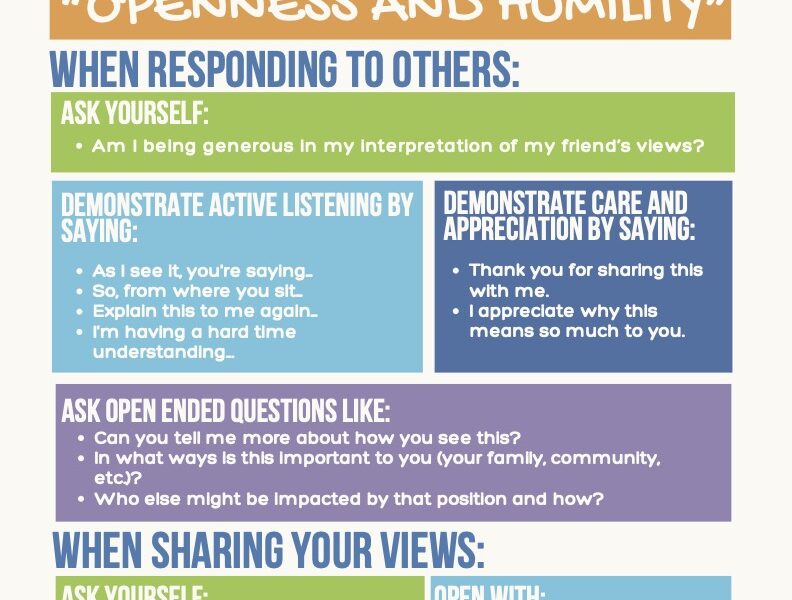
Use of names: In Vaad, we intentionally address each speaker by name. In the flow of classroom discussion, it has become increasingly natural for students to name the person they are responding to, helping peers feel seen and acknowledged. Using names also encourages student-to-student interaction rather than positioning all dialogue through the teacher.
Reflecting back: Students learn that taking a few seconds to articulate what they heard a classmate say can meaningfully advance a conversation. Sometimes a peer responds with an enthusiastic nod, as if to say, “Yes, you got me!” Other times the response is, “Actually, that’s not what I meant,” which invites clarification. In both cases, students engage in authentic discourse in which every participant is valued.
Waiting before inserting yourself: Anyone who has spent time in a classroom recognizes the “I’m up next” phenomenon: being so focused on what you want to say that it becomes difficult to truly hear others. In Vaad, students only speak about “what resonates with me” after first reflecting back what a peer has said. In the day to day of classroom learning we are seeing more students pause to reflect on the thoughts of others before speaking about themselves.
Everyone responds: Many Vaad protocols include quick prompts to which every student must respond; there is no passing. The underlying message is that everyone has something valuable to contribute. More and more, teachers are adapting “everyone responds” structures into everyday teaching, ensuring that quieter voices are heard.
As we listen to each other, so too we can listen to Torah. The first step in learning a few lines of Gemara or a perek of Tanakh can be simply reflecting back what the text is saying. I want my students to listen to the text on its own terms before moving to analysis or personal response. This pause marks Torah as kadosh: I do not rush to insert myself; I first grant respect to the words of Torah themselves. Once we have truly “heard” the text, we can offer it further respect through analysis, questioning, and personal connection. Another way to listen to Torah is to ask students to embody an opinion they find challenging: “You are Rav. Explain why a thief who intends to kill is allowed to keep what he stole.”
Ultimately, what I want for my students as learners of Torah is to embrace its wisdom, see themselves reflected in Torah, and add their own voice. I do not want them to read quickly, explain superficially, and move on, nor do I want them to read solely for the purpose of taking a position. If we pause to listen to Torah, our analysis and personal connection will be deeper and more nuanced.
In the Gemara itself, listening is the language of learning: ta shema, “come and hear,” when a proof is brought; mashma, “it’s heard from this,” as a conclusion; and shema mina, “hear from this,” when bringing an inference. Our schools can embrace this ideal by explicitly cultivating the practice of listening—to Torah and to each other.
“Each of our classrooms features this poster, reminding students of the principles they learn in Vaad and encouraging them to listen and respond carefully in all of their classes and interactions.”